





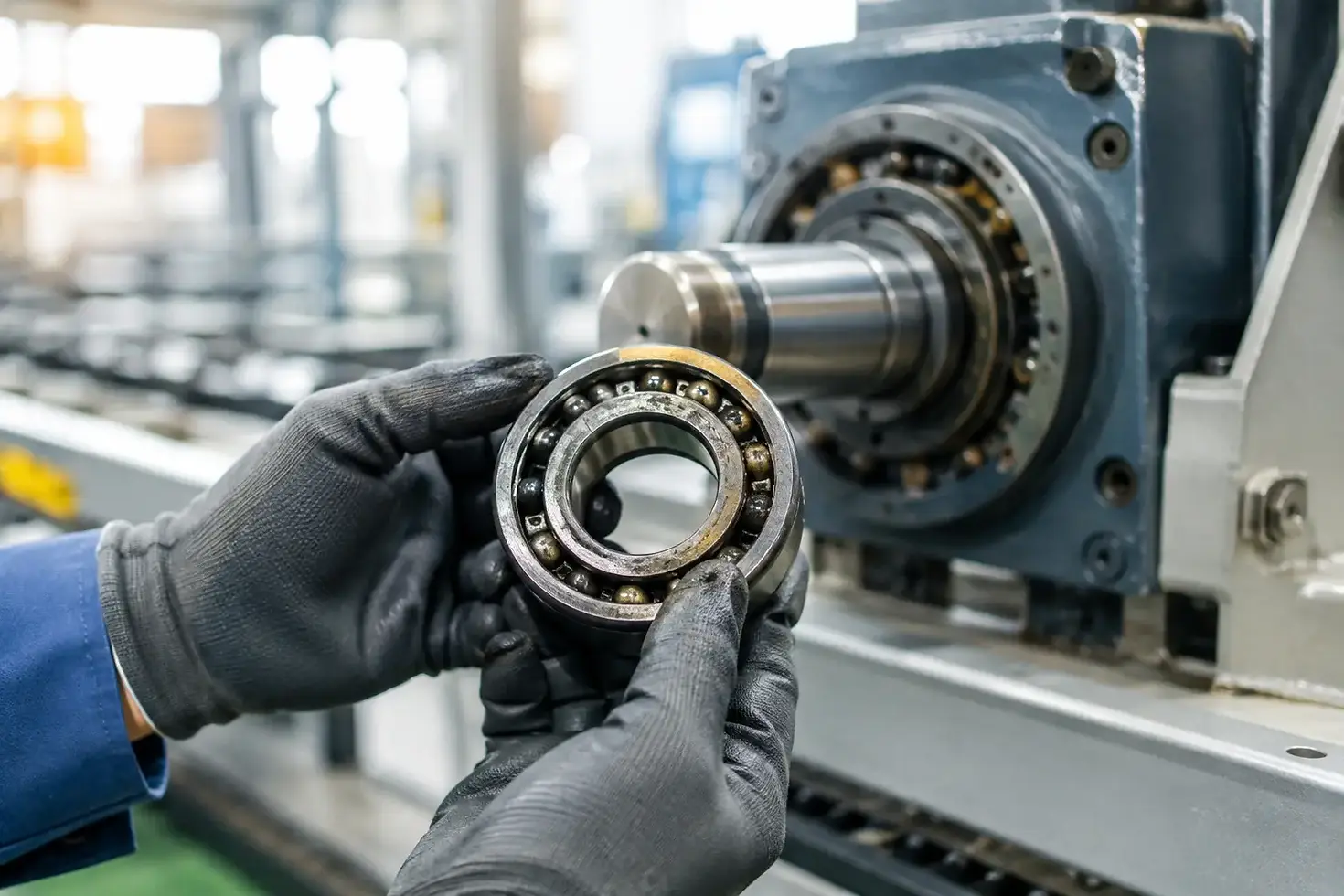
Top Signs of Bearing Failure on Production Lines

A conveyor roller starts to rumble halfway through a shift. A pump motor feels hotter than usual. Operators notice a faint metallic sound that disappears beneath normal production noise. These are often the top signs of bearing failure, and they rarely stay minor for long. Left unchecked, a worn bearing can damage shafts, housings, belts, couplings and product flow before it brings a critical machine to a stop.
For maintenance and production teams, the aim is not to replace every noisy bearing at the first hint of trouble. It is to recognise the warning signs, establish the real cause and plan intervention before an avoidable failure turns into extended downtime. The right response depends on the machine’s criticality, the condition trend and whether safety or product quality is already at risk.
Why bearing faults escalate quickly
Rolling element bearings operate under constant load, speed and temperature. When lubrication deteriorates, contamination enters the raceway, alignment is lost or fatigue develops, the bearing generates additional friction. That friction creates heat and vibration, which accelerates wear and transfers stress into connected components.
On a non-critical roller, this may allow time for a planned change during the next maintenance window. On a main drive motor, fan, gearbox or process pump, the same fault can stop an entire line. The cost is rarely limited to one bearing and a few hours of engineering time. Lost output, missed dispatches, overtime, damage to associated equipment and safety exposure all add to the impact.
Top signs of bearing failure to investigate
Unusual noise that changes with speed or load
A healthy bearing should run with a consistent, low mechanical sound. Grinding, rumbling, squealing, clicking or a repeating knock can indicate damaged rolling elements, raceway wear, poor lubrication or contamination. On conveyors, the sound may become more apparent as the belt load rises. On motors and fans, it may increase with speed.
Noise alone is not a final diagnosis. A loose guard, worn chain, coupling issue or gear fault can produce similar symptoms. However, a new or worsening sound deserves investigation while the machine is still operational, not after it has seized.
Rising vibration levels
Vibration is one of the most reliable early indicators of bearing deterioration. As a defect develops on the inner race, outer race, cage or rolling elements, it creates repeating impacts that can often be identified through vibration analysis. Even without permanent monitoring, engineers may notice a change in machine feel or see evidence of movement at the bearing housing.
The key is comparison. A single vibration reading has limited value unless it is clearly excessive, but a consistent upward trend from a known baseline provides a strong case for action. Critical assets benefit from routine condition monitoring because it gives maintenance teams time to order parts, schedule labour and avoid a reactive repair.
Excessive heat at the bearing housing
A bearing housing running hotter than comparable equipment is a clear warning sign. Excess heat may come from friction, incorrect grease quantity, unsuitable lubricant, contamination, over-tight fitting or misalignment. A thermal check is quick, but readings must be interpreted in context: ambient temperature, process load, speed and the temperature of similar assets all matter.
A sudden temperature rise is more urgent than a stable, known operating temperature. If heat is accompanied by noise, vibration or discoloured grease, reduce the risk promptly and assess whether the equipment can safely remain in service.
Grease leakage, discolouration or contamination
Lubricant tells a useful story. Grease escaping from seals can point to over-greasing, damaged seals, high operating temperature or excessive internal movement. Darkened, burnt-smelling or gritty grease suggests overheating or contamination, while water ingress can cause corrosion and wash away the lubricant film needed to protect the bearing surfaces.
Adding more grease is not automatically the answer. Over-greasing can raise operating temperature and damage seals, particularly on high-speed electric motors. Confirm the correct grease type, quantity and lubrication interval for the application, then investigate why the existing lubricant has deteriorated.
Excessive play or shaft movement
Radial or axial play at a shaft can indicate bearing wear, incorrect fitment or a damaged housing. On stopped equipment, qualified engineers may detect movement during a controlled inspection. In operation, it may appear as pulley wobble, coupling movement, poor belt tracking or an unstable conveyor roller.
This symptom should be treated seriously because movement can quickly affect alignment. Once a shaft is no longer running true, the load on the replacement bearing may be wrong from the moment it is installed.
Repeated belt, coupling or alignment problems
A bearing fault is not always the first cause. Misalignment, poor tension, bent shafts, soft foot on a motor base or damaged couplings can overload a bearing and shorten its life. Equally, a failing bearing can create the movement that causes belts and couplings to wear prematurely.
Where the same drive repeatedly needs adjustment or the same bearing location keeps failing, treat it as a system issue rather than a parts issue. Checking alignment, mounting faces, shaft condition, load and lubrication practice is more productive than fitting another bearing and hoping it lasts.
Higher motor current or reduced machine performance
As friction increases, a motor may draw more current to maintain speed and torque. Pumps may lose efficiency, fans may struggle to hold airflow and conveyors may become less consistent under load. These changes can be subtle, particularly where the control system compensates for a developing mechanical problem.
Trend data from motor drives, current monitoring or the PLC can support the mechanical diagnosis. It should not replace physical inspection, but it can help identify an issue before an operator notices a complete loss of performance.
How to confirm the fault without creating more disruption
Start with a controlled visual and audible inspection. Ask operators when the symptom first appeared, whether it changes with product, speed or temperature, and whether the machine has recently been cleaned, adjusted or repaired. Production-floor observations often reveal a pattern that is missing from a breakdown report.
Then compare the suspect asset with an equivalent machine where possible. Check temperature, vibration, lubrication condition, fasteners, guards, belt or chain tracking, coupling condition and evidence of shaft movement. For critical machinery, vibration analysis and thermal imaging can distinguish a likely bearing defect from imbalance, misalignment or a gearbox issue.
If intervention is required, isolate energy sources fully and follow site lock-off procedures before guards are removed. Bearing replacement may look straightforward, but incorrect removal or installation can damage the shaft, housing or new bearing. Cleanliness, correct fit, suitable tools and accurate alignment all influence service life.
Decide when to monitor and when to stop
Not every suspected bearing fault requires an immediate shutdown. If vibration and temperature are stable, the machine is non-critical and no safety risk exists, planned replacement may be the most sensible route. This gives the team time to secure the correct bearing, seals and any associated components, rather than making a rushed decision during a line stoppage.
Immediate action is more likely where the bearing is overheating, producing severe noise, showing rapid vibration growth or affecting a safety-critical drive. The same applies where a seized bearing could damage a shaft, create a fire risk or contaminate a product area. The decision should balance output requirements against the much greater disruption of a catastrophic failure.
Prevent the next bearing failure
The most effective bearing strategy is built around repeatable basics: correct lubrication, clean working practices, appropriate sealing, alignment checks and condition monitoring for assets that would cause significant downtime. It also needs accurate failure records. Recording the bearing location, damage pattern, grease condition, load conditions and installation details helps identify recurring root causes.
MechElecPro Solutions supports production teams with hands-on fault finding, planned maintenance and rapid breakdown response when internal engineering resource is stretched. The practical focus is to restore safe operation, identify what caused the fault and reduce the chance of the same issue returning on the next shift.
A bearing rarely fails without leaving clues. Giving those clues attention while the machine is still running can protect your maintenance window, your spares budget and the production plan that depends on both.


Comments