
.png)





How to Improve Conveyor Belt Performance and Reduce Downtime

Updated: Oct 1
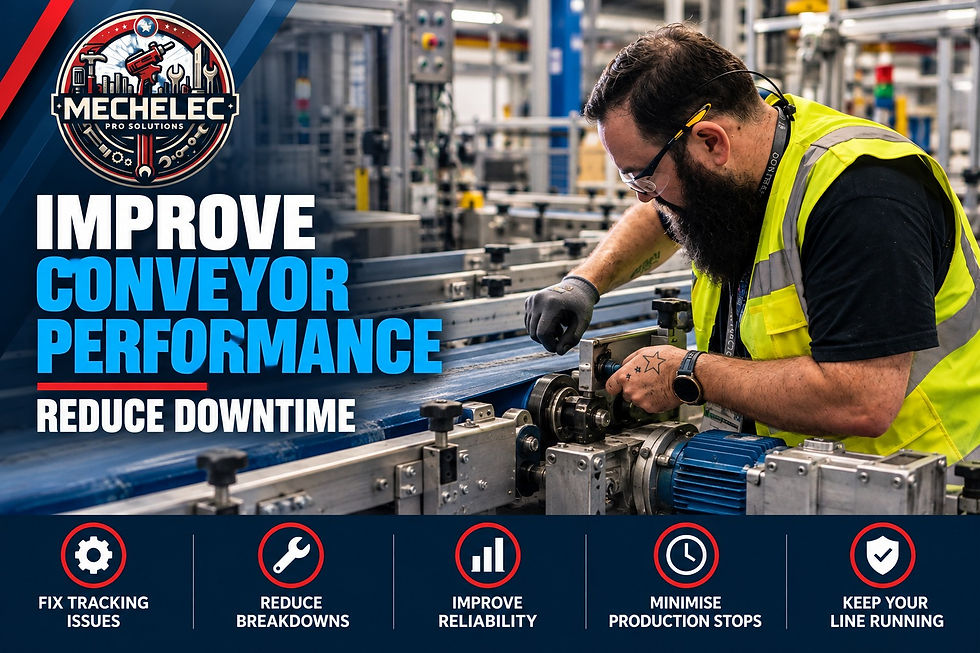
A conveyor belt does not have to completely fail to cost a manufacturing site money.
A belt that continually drifts to one side, slips under load, damages product or causes intermittent trips can quietly reduce production for days or weeks. Operators reset it, maintenance makes another adjustment, production starts again — and the same problem eventually returns.
Improving conveyor belt performance is therefore about much more than increasing speed. It means identifying the mechanical, electrical or control issue that is limiting the conveyor and removing the cause of repeated stoppages.
For manufacturing and processing sites, a reliable conveyor should move product consistently, interact correctly with the machinery around it and give operators and engineers useful information when something goes wrong.
Common Conveyor Belt Problems That Affect Production
Some conveyor problems are obvious. Others develop gradually and become accepted as part of running the line.
Common issues include:
Belt tracking repeatedly moving out of alignment
Belt slipping at the drive
Worn or seized rollers
Damaged bearings and pulleys
Incorrect belt tension
Product jamming at transfer points
Packs colliding or accumulating incorrectly
Photoelectric sensors giving intermittent signals
Motors or drives tripping
Poorly adjusted guide rails
Conveyor speed being mismatched with other machinery
Recurring PLC or control-system faults
A conveyor that requires frequent operator intervention should not automatically be considered normal.
Repeated resets and adjustments often indicate an underlying mechanical, electrical or controls problem that has never been properly resolved.
Start With the Root Cause, Not the Symptom
One of the biggest mistakes when dealing with recurring conveyor problems is repeatedly correcting the symptom.
Consider a belt that continually tracks towards one side.
The immediate response may be to adjust the tracking. But if the problem returns, the belt itself may not be the actual cause.
The engineer should also consider:
Pulley alignment – Is the drive or tail pulley correctly aligned?
Roller condition – Are rollers seized, damaged or contaminated?
Bearings – Is excessive wear allowing movement?
Conveyor structure – Is the frame square and securely supported?
Belt tension – Is tension correct across the belt?
Contamination – Is product, adhesive, moisture or debris affecting the running surface?
Loading – Is product entering the conveyor unevenly?
Finding the root cause can turn a recurring production problem into a permanent repair.
Conveyor Belt Tracking and Tension
Correct tracking and tension are fundamental to conveyor reliability.
A poorly tracking belt can damage belt edges, guides, rollers and surrounding equipment. In severe cases, it can eventually cause the conveyor to stop completely.
Excessive tension creates different problems. Bearings, shafts and drive components can be subjected to unnecessary loading, potentially reducing their working life.
Too little tension can cause belt slip, inconsistent movement and poor acceleration.
Tracking problems should therefore be investigated systematically rather than continually compensated for with adjustments.
The mechanical condition of the entire conveyor needs to be considered.
Check Rollers, Bearings, Pulleys and Drives
Conveyors contain many components that gradually deteriorate.
A single seized roller might initially appear insignificant, but it can increase friction, damage the belt and place additional load on the drive system.
During conveyor inspections, engineers should look for:
Noisy or rough bearings
Seized rollers
Damaged pulley surfaces
Loose components
Abnormal vibration
Gearbox leaks
Motor overheating
Belt wear
Damaged belt joints
Excessive contamination
Finding these problems during planned maintenance is usually far less disruptive than discovering them after the conveyor has stopped production.
Improve Conveyor Transfer Points
Transfer points are responsible for a significant number of seemingly random conveyor problems.
Products have to move cleanly from one conveyor or machine to another. Even a relatively small gap, height difference or speed mismatch can create instability.
Lightweight packaging may tip.
Flexible packs can catch.
Cartons can rotate.
Containers can collide.
Products may also block sensors and create downstream faults that appear unrelated to the original transfer problem.
The solution could involve adjusting conveyor heights, modifying guide rails, changing a transfer plate or altering the relative speeds of two conveyors.
The important point is to observe the product while the line is actually running.
Static inspection alone does not always reveal what happens at production speed.
Match Conveyor Speed to the Production Line
Faster does not automatically mean more productive.
A conveyor running faster than the machine downstream can simply deliver product into a bottleneck more quickly.
This can cause accumulation, collisions, blocked sensors and unnecessary stops.
Conversely, a conveyor running too slowly can starve downstream machinery and prevent equipment from reaching its potential output.
Where variable speed drives are installed, conveyor speeds can often be adjusted to create controlled product spacing and smoother transfers.
The objective should be stable product flow across the complete production line, rather than maximum speed from an individual conveyor.
Sensors and Controls Can Cause Conveyor Problems Too
Not every conveyor fault is mechanical.
Modern production lines rely heavily on photoelectric sensors, proximity switches, safety circuits, variable speed drives and PLC control.
An intermittent sensor can repeatedly stop an otherwise healthy conveyor.
The cause could be:
Incorrect sensor positioning
Vibration
Damaged wiring
Contamination
Reflective packaging
Transparent product
Poor mounting
Incorrect timer settings
PLC sequence problems
If operators continually clean, move or adjust the same sensor, that is useful maintenance information.
The better solution may be to change the sensor type, improve its mounting or modify the control logic.
For older equipment, targeted PLC and controls upgrades can also improve diagnostics and make future conveyor faults much easier to identify.
Reduce Recurring Conveyor Breakdowns With Planned Maintenance
Once a conveyor problem has been corrected, the work should not stop there.
The repair should inform the maintenance programme.
For a production-critical conveyor, planned inspections could include:
Belt condition and tracking
Belt tension
Roller condition
Bearing condition
Pulley alignment
Motor and gearbox condition
Drive-system inspection
Sensor cleanliness and alignment
Guide rails
Transfer points
Guarding
Emergency stops and safety devices
This helps turn breakdown knowledge into preventative maintenance.
If a particular roller, sensor, bearing or belt joint has previously caused significant downtime, that information should influence future inspection frequency and spare-parts availability.
Do Not Ignore Small Recurring Conveyor Faults
One of the clearest warning signs of a future breakdown is a fault that everyone already knows about.
A conveyor that “occasionally needs resetting” or a belt that “always needs adjusting” may continue running for months.
But every intervention represents lost production time and an unresolved reliability problem.
These small faults are often ideal targets for maintenance backlog reduction because resolving them can remove repeated disruption without requiring a major engineering project.
Safety Must Remain Part of Conveyor Improvement
Any conveyor modification must consider safety as well as production performance.
Changes to belt speed, transfer arrangements, accumulation or controls can affect access to moving machinery and introduce new risks.
Guarding, emergency stops, pull-wire systems, safety interlocks and isolation arrangements should therefore be considered whenever significant conveyor modifications are made.
Increasing output should never come at the expense of safe operation.
Conveyor Engineering Support From MechElecPro Solutions
MechElecPro Solutions supports manufacturing and industrial sites with practical conveyor fault finding, repair, maintenance and improvement work.
Our mechanical, electrical and controls capabilities allow us to investigate the complete conveyor rather than looking at one component in isolation.
Support can include conveyor belt repairs, tracking problems, bearings and rollers, motors and gearboxes, sensors, electrical faults, PLC diagnostics, variable speed drives, transfer improvements and planned preventative maintenance.
Whether you have a conveyor that has stopped completely or a recurring fault that is slowly affecting production, the objective is the same: identify the actual cause, complete a practical repair and improve the reliability of the equipment going forward.
Need Hellp to improve conveyor belt performance
Need help with a conveyor problem or recurring production fault?
Call MechElecPro Solutions on 01788 624762Email support@mechelecprosolutions.com


Comments